 |
|
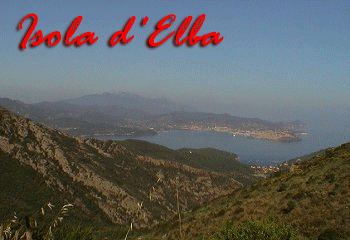
Welcome to the Elba Island (Isola d'Elba). I was very fortunate during the late spring of 2001 to be able to visit Elba Island off the coast of Italy. My host, Dr. Alessandro Genazzani who manages a website for minerals, was kind enough to organize two field excursions during our two and a half day stay to visit two very interesting mineral localities. More about those later. First a brief history of Elba Island.
You can not fully appreciate Elba Island
until you see it first hand. On the map it looks small but when you
are there the mountains which reach to over 1,000 meters (3,000 feet) and
drop steeply into the aqua colored coast simply overwhelm you. This
is a very beautiful Island and the Italian government has taken measures
to ensure these remarkable qualities into the future.
 |
View from the western end of the island.
Not only is the land rich in natural beauty but also extensive history. The island's mineral deposits were worked for over 3000 years - first by the Ligurians who more or less started the iron age and then by the Etruscans 2500 years ago who refered to the island with the Ligurian name Aethalia - pronounced eye-tal-ee-ya (it is clear that the island has an important place in the name if Italy). The name was derived from the view of the fires from the smelters on the east end of the island at present day Portoferraio and Rio Marina. The myth of the sailors passing by was that the god Vulcan was preparing iron for Mars the god of war. The name of the island was later referred to as Ilva - a latin word - in reference to the dark rocks found on the island. Finally, the name Elba was given to the island due to the translation since the latin letter "v" was similar to the letter "b" of the Romans. Iron was the impetus for settling this island and it played an important role in the economy of the island until 1981 when the last of the iron mines was closed.
Tourmalines
The first quarry where colored tourmalines were first found was operated in 1805 for the extraction of granite for construction of homes and roads. About 15 years after the quarry was opend a captain named Foresi, who had a keen interest in geology and minerals, noted the presence of large colorful crystals. In 1830 he bought the property for the sole purpose of extracting these colorful and as yet undescribed crystals. The mine was called Grotta d'Oggi or Cave of Today. Foresi also noted the continuation of the pegmatite zone and found several other productive zones with colored crystals. During his 60 year control of the properties over 5000 specimens of crystallized specimens were removed.
In 1902 the Firenze Mineral Museum purchased
the entire collection and moved it to Firenze. The purchase price
was around 6,000 Lire which in today's money would be equal to about 3
million dollars US. In the early 1900's professor Dachiardi performed
a systematic analysis of much of the catalogued collection and described
in detail the beautiful crystals of tourmaline. He ascribed the varietal
name elabite in reference to the name of the island where they were found.
 |
This map provides a nice overview of the island's geography.
For reference the island is about 20 km in length.
The Iron Mines
of Elba
Tourmaline from
Elba
Trinity
Mineral Co